Electron EDM search (ACME collaboration)
The electron Electric Dipole Moment (eEDM) is a background-free probe of general new CP-violating physics. New physics with CP-violation generally predicts finite eEDM at an observable level in the Advanced Cole Molecule Electron (ACME) experiment. We are aiming to measure the eEDM at 3*10^-31 e・cm level, which corresponds to about 50 TeV scale CP-violating physics.

Several features are important to reach a high sensitivity, and we use the Thorium Monoxide (ThO) molecule to achieve them.
High Electric Field
ThO has an internal electric field of 80 GV/cm, which is ~1,000,000 times larger than lab electric fields.Long Coherence Time
ThO's science state 3Δ1 state has low excited energy, and its decay to the ground state is forbidden to the lowest order.Low B-field Sensitivity
ThO's science state 3Δ1 has nearly zero g-factor, which makes magnetic field control much easierInternal Comagnetometer
In the ThO's science state 3Δ1, one can selectively align or anti-align the electron's spin to the internuclear axis. Since the internal electric field is aligned with the internuclear axis, this gives a spectroscopic reversal of the applied electric field without physical, electrical, or magnetic change of experimental parameters.High Flux
ThO is known to be one of the best molecules to be produced by the cryogenic buffer gas beam (CBGB).Simple Nuclear Structure
Both 232Th and 16O do not have nuclear spins, which makes all controls (cooling, state preparation, readout, etc) efficient.Convenient Transition Wavelength
All transitions required for cooling, state preparation, and readout are in red to NIR range, which is easily accessible with commercial diode lasers.
The ACME experiment is an ongoing experiment at Northwestern University.
- beamline (without the magnetic shield)

- beamline (with the magnetic shield)


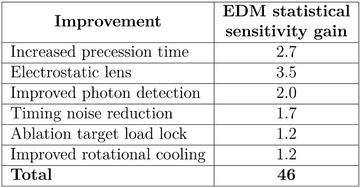
The anticipated statistical gain is summarized on the right. Toward this goal, we are working on the construction of the experiment. We aim to start taking data in the middle of 2024.
A rebuilt vacuum chamber with large rectangular magnetic shields (B< 10 uG) allows 5 times longer spin precession.
A hexapole electrostatic molecular lens is installed to collimate the ThO beam.
Silicon Photo-Multiplier (SiPM) will be used to improve the collection efficiency.
Improved data-acquisition hardware reduces timing jitter noise and improves systematic rejection
The ablation target can be changed regularly with a load lock system to increase the duty cycle.
A compact and more efficient rotational cooling is implemented.